Labels

10 Commandments (2) 10 horns (1) 13th century (1) 17th century (1) 1844 (3) 1888 (1) 19th century (3) 1st century (3) 5th century (1) 666 (1) 7th century (3) Africa (5) alchemy (1) alcohol and drugs (2) Aleister Crowley (2) Alexandria (2) alpha state (2) Alphonsus de Liguori (2) amusements (1) antediluvian technology (11) antediluvian world (5) anti-Semitism (3) Apatosaurus (1) Appalachian tribe (1) Arapaho (1) Archimedes (1) Armenians (1) Ashanti (1) assumption (3) Assyrian (1) automatic writing (2) Aztec (2) Babylon (3) Bahá'í Faith (1) battery (1) Beach Boys (1) Bible (5) Bible prohibited (1) Big Bang theory (1) bird tempter (1) blasphemy (3) Blavatsky (1) bright (1) Buddha (1) buildings and monuments (1) Cameroon (1) camp of Israel (1) cancer (2) Carriers (1) casein (1) catholic priest (2) Celts (1) center of the universe (1) Cherokee (1) chewing well (1) China (12) Chipewyan (1) cholesterol (1) Christianity (2) Christmas (1) Chuck Berry (1) cleansing the temple (2) climate (1) Columbia (2) Confucius (4) conspiracy contra Bible (1) Contemplative Prayer (1) cooked food (1) Copernicus (1) Council of Toulouse (1) council of Trent (1) Cozbi (1) Creation (14) creation of man (1) creation vs evolution (4) crossroads - selling your soul (1) dairy (1) Daniel (9) Daniel 3 (1) Daniel 7 (3) Daniel 8 (2) Dark Day (3) David Bowie (1) devil (5) devil worship (1) dinosaurs (4) Do What Thou Wilt (3) Douay-Rheims (3) dove (2) ecumenism (4) education (1) Egypt (7) Ellen G White (1) England (1) eugenics (1) Eusebius (2) evolution (3) Falling of Stars (2) faunus (1) Faust (1) flora and fauna (1) food and disease (1) forgery (1) fossil record (1) four creatures (1) France (2) Francois Rabelais (1) Freemasonry (4) French Revolution (4) full weeks (2) geology (1) George Harrison (1) Germans (1) glimpses of creation (1) Goethe (2) Greek NT text (1) Greeks (1) hadith (1) Haiti (3) Hawaii (6) He that letteth (1) health (7) heaven (1) heavenly sanctuary (2) Hebrew lexicon (1) Hebrew OT text (1) Henry IV (1) Hermeticism (1) High God (4) high priest (6) Hindu (2) Hippolytus (1) Hispaniola (3) Hollywood (3) Hopi (1) Hort (4) Ignatius of Loyola (1) immortality of the soul (1) Incas (1) India (4) Ireland (1) Ishmael (1) Islam (3) Jamieson Fausset and Brown (3) Jerome (3) Jesuit bribery (1) Jesuit colleges (1) Jesuits (17) Jesus (7) Jezebel (1) Jim Morrison (1) John Cassian (1) John Paul II (1) Josephus (3) Kassena (1) Keil Delitzsch (1) Keith Richards (1) Koran (1) Latin Vulgate (2) Law (1) Led Zeppelin (2) lens (5) Leo XIII (1) Lepchas (3) life span (1) lifestyle diseases (1) Lisbon (2) Little Richard (1) Lord's Day (2) Lucifer (3) Lucille Ball (1) Lugbara (1) man made in His image (1) man made of earth (2) mantra (2) Māori (1) Marduk (1) Matthew Henry (2) meaning of names (2) mediation (1) meditation (1) medium (2) Messiah (3) Michael (2) Michael Jackson (1) Middle Ages (1) Mithras (1) Moslems (2) music (12) music industry (1) mysticism (2) mythology (45) natural law (6) Nero (1) New World Order - State and Society (2) New Zealand (1) Noah's Ark (1) North America (1) nuclear weapons (1) Nuku Hiva (1) NWO (1) old woman of prophecy (1) optics (1) Ottoman Empire (1) Papas (1) Paul VI (2) pentagram (2) Pergamos (1) persecution of saints (1) Persius (1) Petronius (1) Pius IX (1) Plato (1) pleasure (4) pope (1) press (1) Prophecy (38) protein (1) psychology (1) pterodactyl (1) racism (2) radiocarbon dating (2) raw food (2) Revelation (23) Rock and Roll (10) Rolling Stones (1) Roman Catholic church (20) Roman Empire (6) Romans (1) Rome (6) Sabbath (20) sacrifice (2) Saint Patrick (1) Samuel Morse (2) Scotland (2) secret societies (1) Seneca (1) separation God and man (5) serpent (5) serpent-bird (2) ShangTi (3) Signs of Christ' Return (7) Simon Magus (1) Sioux (1) Sixth Seal (7) sky god (4) Soviet Union (1) spirit (1) Spirit upon waters (3) Spiritualism (6) star (1) Suebi (1) Sumerians (2) sun worship (2) Sunday (4) Sunday Law (1) supreme being (1) Sylvester I (1) Tacullies (1) ṭâhêr (1) Taino (3) Taiping Rebellion (2) Tamburini (1) telescope (3) television (1) Textus Receptus (1) the Doors (2) the Fall (27) the Fall and food (2) the Flood (9) The Great Earthquake (2) the home (1) the Sanctuary (2) the Septuagint (1) the Sun (1) the Tower of Babel (3) the week (1) Thelemites (2) Theosophy (2) Thessalonians (2) Thomas Aquinas (3) tree in middle of garden (2) Trinity (1) tsâdaq (1) United States (6) Vatican II (1) Vaticanus (3) Washington (2) Westcott and Hort Textual theory (1) witchcraft (2) woman from man (1) woman in tree (1) words (2) Zimbabwe (1)
Showing posts with label the Flood. Show all posts

Sunday, 21 September 2014

Lepcha Tradition of the Flood (2)

Tendong, "the up-raised horn," is the mountain which the Lepchas assert arose when all the country was under water, and supported a boat containing a few persons, all other people being drowned. The hill rose up like a horn (hence its name) and then subsided to its present form.
Bengal (India) Secretariat, eds., The Gazetteer of Sikhim, intro. Herbert Hope Risley, Calcutta: Printed at the Bengal secretariat press, 1894, p. 42.

Lepcha Tradition of the Flood

The Lepchas possess a tradition of the flood, during which a couple escaped to the top of a mountain (Tendong) near Dorjiling.
Hooker, Joseph Dalton, Himalayan Journals; or, Notes of a Naturalist in Bengal, the Sikkim and Nepal Himalayas, the Khasia Mountains, &c., 2 vols., London: John Murray, 1854, vol. 1, p. 127.


Friday, 22 November 2013

The Flood According to the Apppalachian Tribe in Florida

The Appalachian tribe in Florida is a relic of a more ancient nation than the North American Indian tribes. They relate that the lake Theomi burst its bounds, and overflowed the earth, and stood above the top of the highest mountains, saving only the peak Oldamy, on which stood a temple to the sun. Those men who had succeeded in reaching this temple were saved, but all the rest of mankind perished.
Baring-Gould, Sabine, Legends of Old Testament Characters, London and New York: MacMillan and Co., 1871, p. 104.


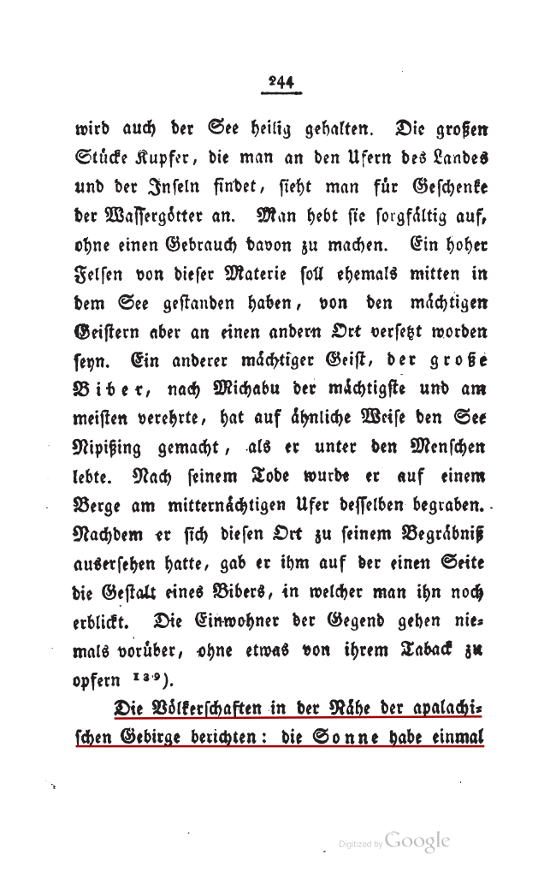
Die Völkerschaften in der Nähe der apalachischen Gebirge berichten: die Sonne habe einmal ihren gewöhnlichen Lauf vier und zwanzig Stunden zurückgehalten. Darauf waren die Gewässer des großen Sees Theomi dergestalt ausgetreten, daß sie auch die Gipfel der höchsten Berge bedeckt hätten, ausgenommen den einzigen Olaimy. Auf demselben hatte sich die Sonne mit eigenen Händen eine Wohnung bereitet; darum bewahrte sie ihn vor der allgemeinen Ueberschwemmung, und alle Menschen, welche diesen Ort erreichen konnten, wurden erhalten. Nach Berlauf der vier und zwanzig Stunden begann die Sonne ihren gewöhnlichen Lauf wieder. Durch ihre Kraft wurden die Gewässer in ihre Gränzen zurückgebracht, und die Dünste, welche dadurch auf der Erde verbreitet worden waren, zertheilt. Aus Dankbarkeit verehrten seitdem die Geretteten, und fortan ihre Nachkommen, die Sonne als eine Gottheit, als eine hülfreiche Retterin, insbesondere auf jenem heiligen Berge.
Majer, Friedrich, Mythologisches Taschenbuch oder Darstellung und Schilderung der Mythen, religiösen Ideen und Gebräuche aller Völker, Weimar: Verlage des Landes-Industrie-Comptoirs, 1811, vol. 1, pp. 244-245.  

[Translation: The tribes near the apalachischen Mountains report: the sun had even withheld their ordinary course of twenty-four hours. Then the waters of the great lake Theomi were such emerged that they had covered the peaks of the highest mountains, except the single Olaimy. At the same, the sun had prepared an apartment with his own hands, so she saved him from the general deluge, and all the people who were able to reach this place, were obtained. After overflow of twenty-four hours the sun habitually run started again. Due to their power, the waters were returned to their bounds, and the vapors which had been thus distributed on Earth zertheilt. Out of gratitude, since worshiped the rescued, and from then their descendants, the sun as a deity, as a savior of a helping, especially on that holy mountain.]


Thursday, 21 November 2013

The Creation/Flood According to the Carriers

The Carriers give the following account of the tradition, which they believe, respecting the formation of the earth, and the general destruction of mankind, in an early period of the world. Water at first overspread the face of the world, which is a plain surface. At the top of the water, a muskrat was swimming about, in different directions. At length he concluded to dive to the bottom, to see what he could find, on which to subsist; but he found nothing but mud, a little of which he brought in his mouth, and placed it on the surface of the water, where it remained. He then went for more mud, and placed it with that already brought up; and thus he continued his operations, until he had formed a considerable hillock. This land increased by degrees, until it overspread a large part of the world, which assumed at length its present form. The earth, in process of time, became peopled in every part, and remained in this condition for many years. Afterwards a fire run over it all, and destroyed every human being, excepting one man and one woman. They saved themselves by going into a deep cave, in a large mountain, where they remained for several days, until the fire was extinguished. They then came forth from their hiding place; and from these two persons, the whole earth has been peopled.
Harmon, Daniel Williams, A Journal of Voyages and Travels in the Interior of North America, Andover: printed by Flagg and Gould, 1820, pp. 302-303.


Tuesday, 19 November 2013

The Flood According to the Cherokee

It is affirmed by Cherokee tradition, said my informant, that the water once prevailed over the land, until every person was drowned, but a single family. The coming of this calamity was revealed by a dog to his master. This dog was very pertinacious in visiting the banks of a river, for several days, where he stood gazing at the water, and howling piteously. Being sharply spoken to, by his master, and ordered home, he revealed to him the coming evil. He concluded his prediction by saying, that the escape of his master and family from drowning, depended upon their throwing him into the water; that to escape drowning himself, he must make a boat, and put in it all he wished to save; that it would then rain hard, a long time, and a great overflowing of the land would take place.
The dog then told his master to look for a sign of the truth of what he had said, to the back of his neck. On turning round, and doing so, the dog's neck was raw and bare, the bone and flesh appearing. By obeying this prediction, one man and his family were saved, and from these rescued persons, the earth, they believe, was again peopled.
Schoolcraft, Henry Rowe, Notes on the Iroquois, Albany: Erastus H. Pease & Co., 1847, pp.358-359.


Thursday, 31 October 2013

The Flood According to the Arapaho

Sherman Coolidge, an educated Arapaho, some years ago wrote an account of the Arapaho tradition of the flood, from which the following has been adapted: Long ago, before there was any animal life on the earth, the entire surface of the planet was covered with water, except the top of one high mountain. Upon this mountain sat a lone Arapaho, poor, weeping and in great distress. The Great Spirit saw him and felt sorry for him, and in his pity sent three ducks to the poor Indian. The Arapaho ordered the ducks to dive down into the waters and bring up some dirt. The first and second tried, but after remaining under water for a long time each returned without any dirt. Then the third went down and was gone so long that the surface of the water where he disappeared had become still and quiet. The Arapaho believed this duck to be dead when she returned to the surface with some dirt in her bill. As soon as the Arapaho received this bit of earth the waters began to subside.
In a short time the waters had receded so far that they could not be seen from the top of the highest mountain, but this Arapaho, who was endowed with supernatural wisdom and power, knew that they surrounded the earth, even as they do to this day. The Arapaho, who had been saved by the ducks, then became the sole possessor of the land. He made the rivers and made the trees to grow along them, the buffaloes, elks, deer and other animals, all the birds of the air and the fishes in the waters, and all the trees and bushes and all other things that can be grown by planting seeds in the ground.
Then all the other tribes—the Sioux, the Cheyenne, the Shoshone, etc.—came to this Arapaho, poor and on foot, and he gave them ponies. He also taught them to make bows and arrows and how to start a fire by rubbing two sticks together. This Arapaho god also had a peace pipe, which he gave to the people and told them to live at peace with each other, but especially with the Arapaho. The Cheyenne was the first of the tribes to come and receive gifts and knowledge of the Arapaho god. Among the gifts they received were ponies, in the use of which they became expert. The Shoshone had no lodges and the Arapaho taught them to construct skin tepees. Then all the tribes loved the Arapaho.
Bartlett, Ichabod S., History of Wyoming, Chicago: The S. J. Clarke Publishing company, 1918, vol. 1, pp. 62-64.


Sunday, 27 October 2013

The Flood According to the Taino of Hispaniola

They said that there once lived in the island a mighty cacique, whose only son conspiring against him, he slew him. He afterwards collected and picked his bones, and preserved them in a gourd, as was the custom of the natives with the relics of their friends. On a subsequent day, the cacique and his wife opened the gourd to contemplate the bones of their son, when, to their astonishment, several fish, great and small, leaped out. Upon this the cacique closed the gourd, and placed it on the top of his house, boasting that he had the sea shut up within it, and could have fish whenever he pleased. Four brothers, however, born at the same birth, and curious intermeddlers, hearing of this gourd, came during the absence of the cacique to peep into it. In their carelessness they suffered it to fall upon the ground, when it was dashed to pieces, and there issued forth a mighty flood, with dolphins, and sharks, and great tumbling whales; and the water spread, until it overflowed the earth, and formed the ocean, leaving only the tops of the mountains uncovered, which are the present islands.
Irving, Washington, A History of the Life and Voyages of Christopher Columbus, 4 vols., London: John Murray, 1828, v. 2, pp. 118-119.


Sunday, 20 October 2013

Josephus on the Flood

Now all the writers of barbarian histories make mention of this flood and of this ark; among whom is Berosus the Chaldean; for when he is describing the circumstances of the flood, he goes on thus:—"It is said there is still some part of this ship in Armenia, at the mountain of the Cordyaeans; and that some people carry off pieces of the bitumen, which they take away, and use chiefly as amulets for the averting of mischief." Hieronymus the Egyptian, also, who wrote the Phoenician Antiquities, and Mnaseas, and a great many more, make mention of the same. Nay, Nicolaus of Damascus, in his ninety-sixth book, hath a particular relation about them, where he speaks thus:—"There is a great mountain in Armenia, over Minyas, called Baris, upon which it is reported that many who fled at the time of the Deluge were saved; and that one who was carried in an an ark came on shore upon the top of it; and that the remains of the timber were a great while preserved. This might be the man about whom Moses, the legislator of the Jews, wrote." 
 Josephus, Flavius, Antiquities of the Jews, bk. 1, ch. 3, vs. 6.
(Josephus, Flavius, The Complete Works of Flavius Josephus, trans. William Whiston, London: T. Nelson and Sons, 1860, p. 34.)

Monday, 19 August 2013

The Flood Tradition

There is, however, one special tradition which seems to be more deeply impressed and more widely spread than any of the others. The destruction of well nigh the whole human race, in an early age of the world's history, by a great deluge, appears to have so impressed the minds of the few survivors, and seems to have been handed down to their children, in consequence, with such terror-struck impressiveness, that their remote descendants of the present day have not yet forgotten it. It appears in almost every mythology, and lives in the most distant countries, and among them the most barbarous tribes.
Miller, Hugh, The Testimony of the Rocks Or Geology in its Bearings on the Two Theologies Natural and Revealed, 1857, p. 284.